 EquateIt
How to Get the Most Out of Your Tutoring Sessions

Most of what’s written about tutoring stops at the decision to hire one. Once you’ve found a good tutor and the direct debit is running, you’re left to assume the sessions are working because a professional is in the room. That assumption costs families real money — knowing how to get the most out of tutoring sessions matters as much as choosing the right tutor in the first place.
Private tutoring in Melbourne for VCE subjects runs roughly $75 to $130 an hour in person. Over a year of weekly sessions, that’s a few thousand dollars. Whether that money moves a mark or just fills an hour depends almost entirely on things the student and parent control, not the tutor. So if you’ve already worked out whether your child needs a tutor and how to choose a good one, this is the part nobody hands you next: how to actually get value once the sessions start.
How do I get the most out of tutoring sessions?
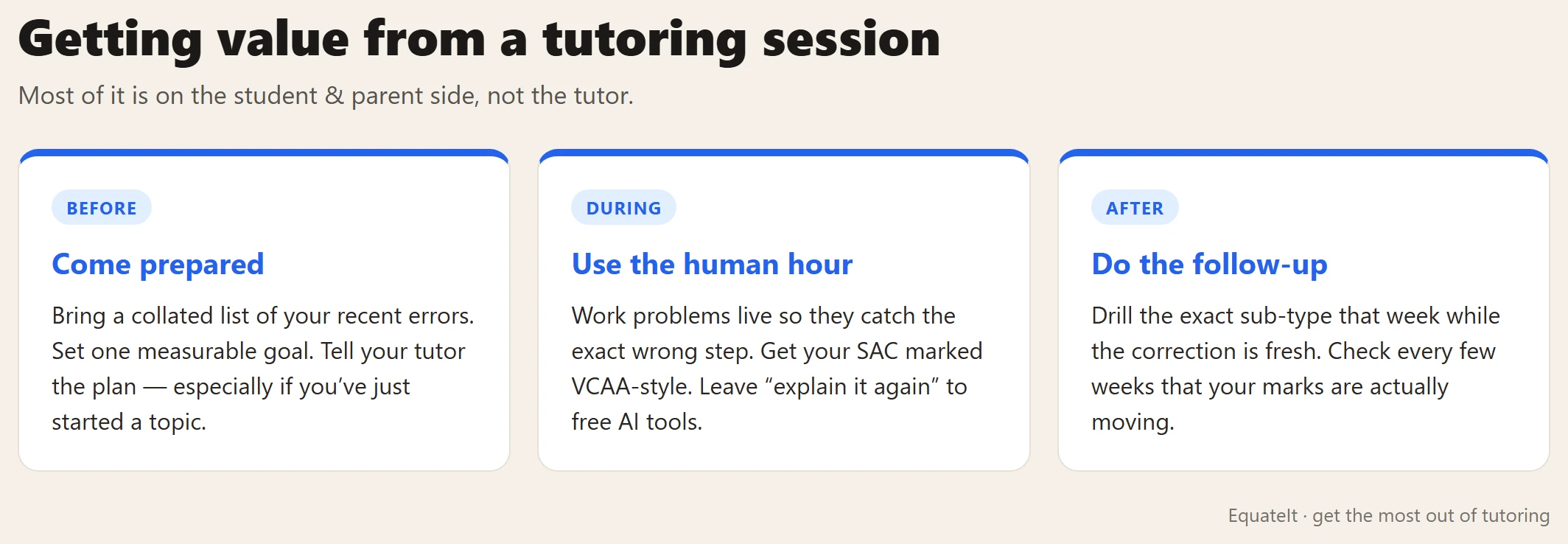
Come to each session with the specific questions and topics you got wrong most recently, not a vague “I’m struggling.” Set one clear goal for the hour before it starts, do the between-session homework because that’s where the mark actually moves, and use your tutor for the things self-study and AI can’t do well, like marking your working the way an examiner would and spotting the pattern in your mistakes. Then check every few weeks whether your marks are actually improving. A tutor who knows exactly where your marks are leaking, working on a student who does the follow-up, is worth far more per hour than a general “let’s go over some maths” session.
Contents
- How do I get the most out of tutoring sessions?
- Come with your actual errors, not “I’m struggling”
- Set one goal for the hour before it starts
- The homework is where the mark actually moves
- Use your tutor for what AI and self-study can’t do
- Review your returned SACs together, not just new material
- Are your marks actually moving?
- Group class or one-on-one: which actually helps?
- What tutoring can and can’t fix
- The short version
Come with your actual errors, not “I’m struggling”
The single biggest difference between students who get huge value from tutoring and students who get almost none is what they walk in the door with.
“I’m bad at Maths Methods” is the most useless thing you can tell a tutor, because you can’t study “bad at Methods.” You can study “I keep losing marks on related rates when the chain rule combines with a word problem.” That’s specific enough for a tutor to build an hour around. When a student turns up with a list of the exact sub-topics they dropped marks on in their last SAC or practice exam, the tutor can target the session at closing those specific gaps instead of teaching whatever they’re most comfortable teaching.
So the job between sessions is simple to describe and easy to skip: after every SAC and practice exam, write down the precise sub-topic of every question you lost marks on. Bring that list. A tutor working from your real errors is a completely different purchase to a tutor working from a generic worksheet, even though the hourly rate is identical.
Set one goal for the hour before it starts
An hour disappears fast. If the session opens with “so, what do you want to look at?”, you’ve already lost ten minutes to figuring it out, and you’ll probably default to whatever feels easiest rather than what’s actually costing marks.
Decide the goal before the tutor arrives. “I want to be able to do optimisation problems with a geometric constraint without looking at the answer” is a goal you can measure at the end of the hour. “Go over calculus” is not. One concrete target per session, chosen from your error list, means the tutor can spend the whole hour on the thing that moves your mark rather than warming up on stuff you’re already fine at.
The practical version of this: prepare a list of questions and have them collated and ready before the session starts, not scribbled out while the tutor waits. And where you can, tell your tutor what you want to cover beforehand, so they walk in with a plan too. This matters most in the case people overlook — you’ve just started a new topic, so you don’t have questions yet because you haven’t hit anything hard. That’s not a wasted session, it’s a chance to tell the tutor “I’ve just begun related rates, can you prepare a proper run at it,” so they arrive ready to teach rather than improvise.
That’s the short version of how to prepare for a tutoring session: know your goal and have your questions ready before the tutor walks in.
The homework is where the mark actually moves
This is the uncomfortable one. The session itself rarely moves a mark. The session shows you what to fix. The fixing happens in the hours between sessions, when you drill the corrected skill until it’s automatic.
When you get a question type wrong, you need more practice on that exact type immediately, not eventually, so the correction is still fresh. Three more questions that test the same skill, done that week, is worth more than a dozen random past-paper questions on topics you’ve already got. This isn’t just a tutoring-business opinion — testing yourself on the corrected material beats re-reading it{target=“_blank”} in controlled classroom studies too.
A student who does the follow-up work turns a $100 session into a genuine gain. A student who treats the session as the entire study effort is paying a professional to watch them stay in the same place. If you’re only going to change one thing after reading this, make it this one: the tutor’s job is to aim the practice, but you still have to do the practice.
Use your tutor for what AI and self-study can’t do
Some of what students book tutors for is now done well, and free, by other tools. It’s worth being honest about that so you spend the paid hour on what’s genuinely hard to get elsewhere.
A good AI study tool can explain a concept a second and third way, generate practice questions, and answer a “why does this step work” question at 11pm. The best AI tools to study VCE covers where those genuinely help. What they’re still poor at is marking your working the way a VCAA examiner would, and noticing the pattern across your last five SACs that you can’t see yourself.
SACs and exams aren’t graded on correctness alone. Method marks, the way a solution is set out, and specific VCAA-style phrasing all cost or save marks that a generically “good at maths” explanation won’t flag. A tutor who can solve the problem but has never marked to a VCAA rubric will teach you to get the right number and still lose marks in the exam room.
So spend the human hour on the human-only things: watching you work a problem live and catching the exact step where you go wrong, marking your practice SAC the way it’ll actually be marked, and connecting mistakes across weeks into a diagnosis. Let the free tools handle the “explain it again” and “give me more questions” work between sessions.
Review your returned SACs together, not just new material
When a marked SAC comes back, most students look at the number, feel something about it, and file it away. That marked paper is the most valuable diagnostic you get all term, and it’s wasted if it never makes it into a session.
Bring returned SACs to your tutor. Go through them together question by question: where did the marks actually go, was it a knowledge gap or a working-out gap, and is this the same type of mistake that showed up last time? This is exactly the kind of pattern-spotting that’s hard to do on yourself and easy for a second set of experienced eyes. A tutor who sees your marked assessments knows where you’re really leaking marks, which makes every future session better targeted.
Are your marks actually moving?
Here’s the check almost nobody does: is it working?
A reasonable general rule from the wider tutoring industry is to check in around the six-to-eight-week mark. If there’s been no change in engagement or results by then, it’s worth a conversation. If you’re wondering whether tutoring sessions are worth it, the honest answer is: only if you’re doing the things on this list — the sessions aren’t the variable, your follow-through is.
“Working” doesn’t have to mean a jumped ATAR by week six. Earlier signals count: is your targeted-revision list getting shorter week on week? Are you getting the once-hard question type right without looking at the answer now? Is your child bringing up the subject at home with less dread?
If none of that is shifting after a couple of months of real effort on both sides, that’s not a reason to give up on tutoring, it’s a reason to change something, usually the fit or the approach rather than the whole idea.
Group class or one-on-one: which actually helps?
Neither is automatically better, and this is the moment to be honest that a tutor is not a magic weapon that lifts a grade just by existing. It comes down to you as a student and what you actually need, because each format has real pros and cons.
A group class is often the more structured option. It’s built to move through the syllabus in order, reteach content properly, and put challenging questions in front of the whole room. If your gap is “I’ve missed or half-understood chunks of the course,” a well-run group can be the more efficient fix.
One-on-one earns its higher price when your gaps are specific and personal. It’s the format that can sit with you on the exact question you keep freezing on, at your pace, for as long as it takes. If you’re mostly across the content but bleeding marks on particular question types, the individual hour targets that in a way a group can’t.
The mistake is treating them as interchangeable. Work out whether you mainly need re-teaching (lean group) or targeted un-sticking (lean one-on-one), and choose on that, not on price alone.
What tutoring can and can’t fix
I run a tutoring business, so it would be easy to tell you a tutor solves everything. It doesn’t, and pretending otherwise wastes your money.
A tutor can close a specific knowledge gap fast, teach exam technique that a “good at maths” student never learns on their own, and give a student the structure and accountability they can’t generate alone. What a tutor can’t do is want it more than the student does. If the homework never gets done and the student is only in the room because a parent booked it, no hourly rate fixes that, and it’s worth addressing the motivation honestly before spending more.
The other honest limit: even a genuinely good tutor can be the wrong fit for a particular student, and that’s fixable by changing the combination, not by deciding your child “just isn’t a maths person.” I grew up in regional Victoria with a family friend tutoring me who genuinely tried but didn’t have the VCAA-specific resources to close my gaps, and it took me years to see that “my tutor is trying hard” and “my tutor has what they need to help me” are two different things. That gap is the whole reason I built EquateIt the way I did.
The short version
Choosing a good tutor is the setup. Getting value is the follow-through, and almost all of it is on the student and parent side: bring your real errors, set a goal per hour, do the homework, save the human hour for what AI can’t do, review your marked SACs together, and check every few weeks that the marks are moving. Do those, and a tutoring hour stops being a cost you hope is working and becomes the most efficient study you do all week.
EquateIt is built around exactly this: tutoring for maths and science in Years 7 to 12 across Victoria, paired with VCAA-aligned marking and progress visibility so you can see where marks are being won and lost between sessions, not just during them.
Because the app runs on our own platform, ClassQuill{target=“_blank”}, the workflow in this post is built in: any homework question your tutor sets can be saved into a running backlog, and the platform surfaces your weak spots to your tutor along with the exact questions worth working through next. If you want to try it on your own terms, start with a free first session. No credit card, 14 days, and you can point this exact checklist at us. If you’re weighing up in-person versus online for VCE, our VCE tutoring in Melbourne page lays out how it works.