 EquateIt
The Night Before Your SAC: Exactly What to Do (and What to Stop Doing)

What should I do the night before a VCE SAC?
The night before a SAC, do not start new content. Pick 2-3 question types you are least confident on, do one question each, mark every step properly, and check your notes or bound reference once if it is open-book — then stop by 10pm and sleep. Your brain consolidates what you have already learned during sleep, so cramming new material at 11pm replaces that consolidation with noise. The night before is for reinforcing what is already there, not filling gaps that needed weeks to close.
Contents
- Why most night-before plans fail
- What not to do tonight
- The two-hour plan
- Does this work for every SAC?
- The morning of
- What do you do if your SAC goes badly?
- One tool that helps at 10pm
Why most night-before plans fail
I remember the night before my first serious Methods SAC. I had this plan in my head: get through every topic I had not properly touched, find a YouTube explainer for the ones I was shakiest on, print a practice exam, and grind until 2am.
That plan lasted about forty minutes before I was too tired to absorb anything and too wired to stop.
What I needed was not a six-hour revision block. I needed a two-hour plan with a hard stop.
The reason most night-before plans fall apart is not willpower. It is that students treat the night before like it is still study time — like there is still a gap to close if they just work hard enough tonight. That window has passed.
The night before a SAC is not when you learn new content. It is when you consolidate what is already built. And consolidation requires far less time and far more sleep than most students give it credit for.
What not to do tonight
These are the things that feel productive but are not — the same patterns that show up at 2am in every SAC season:
- Starting a new topic you have not touched. If you have not covered it, one night will not fix it. You will spend two hours on something shaky and walk in less confident than if you had never tried.
- Watching a 45-minute YouTube explainer. Not because video is bad — but at 10pm the night before, you are not learning. You are procrastinating while watching.
- Doing a full practice exam from scratch. The time cost is too high and the feedback loop is too slow. You will not finish marking it properly before midnight.
- Staying up past midnight cramming. Your brain will not retain new information when it is exhausted. You are burning tomorrow’s focus for tonight’s marginal gain — and it is almost never worth it.
Your brain won’t retain new information at that point. You’re reinforcing exhaustion, not knowledge.
The two-hour plan
Here is what actually works. Two hours, a hard stop, then sleep.
Step 1: Find your 2-3 weakest question types
Not your weakest topic. Your weakest question types.
There is a difference, and it matters.
“I’m bad at calculus” is too vague to act on tonight. “I keep losing marks on chain rule when the function has an implicit term” is specific enough to drill once and feel the difference. One is a vague anxiety. The other is a thing you can do something about in the next two hours.
Saying “I’m bad at Methods” is not useful. Saying “I keep losing marks on related rates and chain rule combinations” is. The more specific you are about what is breaking down, the more targeted your study gets. Broad study is inefficient study.
The pattern I’ve seen again and again: finish a practice exam, note the topics you missed, tell yourself you will go back to them, then two weeks later — SAC day — you are staring at that exact question, having never revisited it. A mental note is not a system.
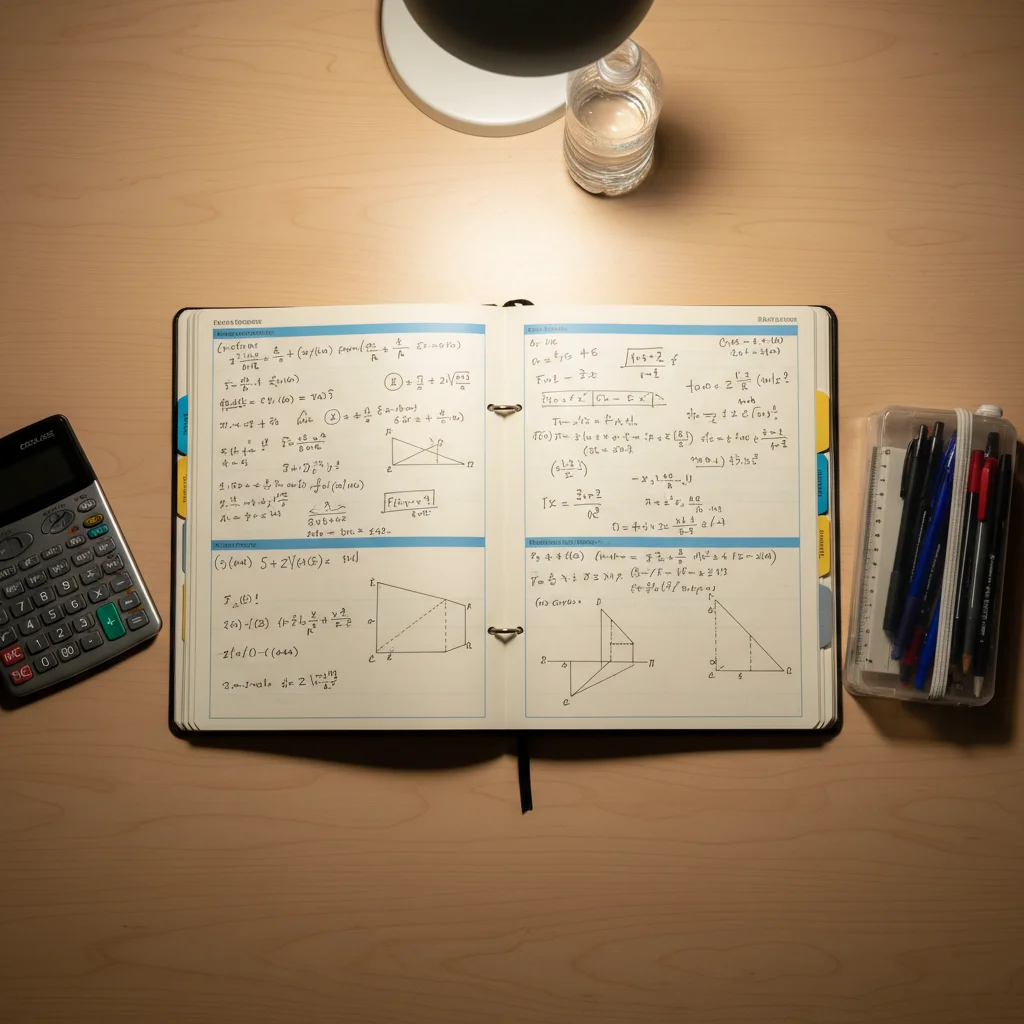
Tonight, go to the most concrete record you have of where marks have actually dropped — marked practice exams, returned homework, your own written list. Pick the 2-3 question subtypes that, if one showed up tomorrow, would drop your stomach.
Step 2: Do one question on each. Mark every step.
One question per type. Not five. Not a whole exercise. One.
The goal is not to master the concept tonight. The goal is to fire that neural pathway one more time before you sleep, so it is active when you walk in tomorrow.
When you mark it, mark properly. Not “close enough.”
A rule of thumb I give students three days out still holds the night before: review your weakness summary, do a small number of targeted questions on the concepts you are still slipping on, and stop early. You retain more from what you have already done than from what you cram the night before.
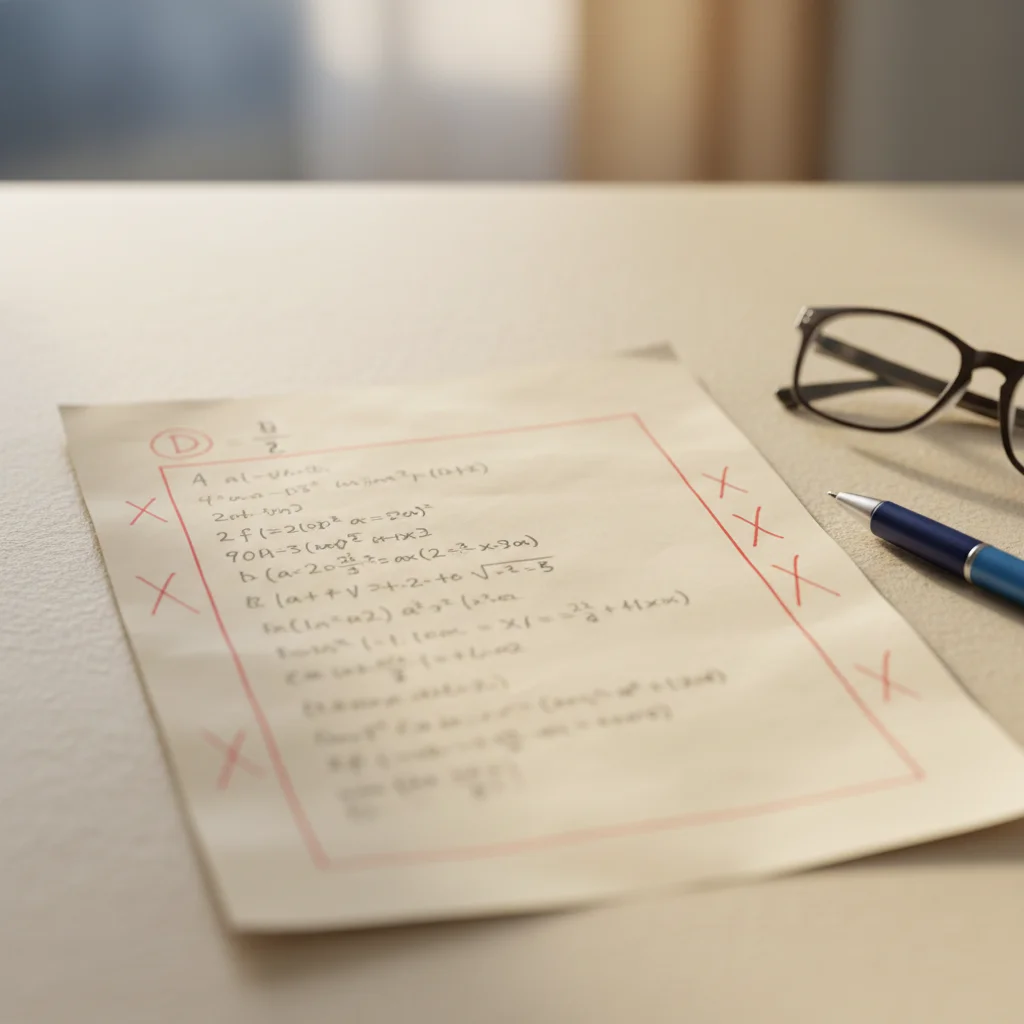
VCAA marks method marks, accuracy marks, and consequential marks. You can get the right answer with the wrong method and lose marks on every step of your working. A right answer with no shown reasoning can cost you everything. So when you mark your practice question tonight, check the method — not just whether the final answer matches.
Step 3: Check your notes or bound reference once (open-book SACs only)
If your SAC is open-book, run a five-minute check: can you find the formula or key definition for each of your 2-3 weak spots? Not a read-through. Just confirm it is in there and you know exactly where to look.
This is not a revision session. It is a navigation check. You want to know where things live, not relearn them from scratch.
If it is a closed-book SAC, skip this entirely.
Step 4: Stop by 10pm. Earlier if you can.
This is not a cop-out. It is the highest-leverage thing on this list.
Sleep is when your brain consolidates what you learned today into something you can actually access tomorrow. Every hour of sleep you trade for revision is an hour where that consolidation does not happen.
You have been building knowledge for weeks. The night before, sleep protects that investment. Staying up burns it.
Put your phone in another room. Set one alarm, not seven. You know the content better than you think you do right now, sitting there at 10pm second-guessing yourself. The test will confirm that in the morning.
Does this work for every SAC?
The structure holds across subjects, but the specifics shift.
Maths SACs (Methods, Further, Specialist): the 2-3 question type approach is the most direct fit. Find your weakest subtypes, drill one question each, mark every step. If it is a SAC where the CAS is allowed, do a thirty-second check for each of your 2-3 topics — can you run that calculation without hunting through menus? Knowing where the function lives on your calculator is the kind of thing that saves a minute under pressure.
English and Humanities SACs: the night before is for re-reading your key quotes and your main arguments, not for rewriting your essay plan. If it is a text response SAC, write one paragraph plan in dot-point form on a prompt you have not practised yet. One. See if your argument holds. Then stop.
Science and Biology SACs: review your key definitions and process steps for the most likely exam topic. If it is an extended response style, write the explanation in dot-points, not full prose. You are checking your reasoning, not practising writing.
The rule is the same everywhere: targeted, specific, timed. Not a full sweep of everything.
The morning of
Three things, nothing more.
- Eat something before you go in. Not a full meal if you are nervous — something. Blood sugar drops mid-SAC are real and they cost you focus exactly when you need it.
- Arrive five minutes early. Walking in scrambling raises your cortisol right before you need to think clearly.
- Skim your 2-3 weak spots one more time on the way in, or at your desk before it starts. Thirty seconds per topic. You are not learning — you are warming up the pathway.
Then close your notes, put them under the desk, and trust the work you have done over the past weeks. That work is already there. Tonight just reminded your brain where to find it.
What do you do if your SAC goes badly?
Sometimes a SAC does not go the way you wanted. You freeze on question 3, you run out of time, the paper lands on exactly the thing you did not have locked in.
If that happens: one SAC is not your study score.
VCE has multiple assessment components — SACs across the year, plus your end-of-year exam. One result — even a difficult one — does not define the final number. What matters more is how you respond in the next week.
When you get your paper back, do not just look at the total mark and move on. Check every lost mark at the step level. VCAA awards method marks (for setting up the problem correctly), accuracy marks (for the right final answer), and consequential marks (for following through correctly from a wrong step).
You can get the right answer with the wrong method and lose marks. You can make an error in step two and still pick up consequential marks if you follow through consistently. Understanding which steps cost you what is the diagnostic that shapes your next few weeks of revision — not just a number to feel about.
One tool that helps at 10pm when you are spiralling
If you are at 10pm and you know you need 2-3 targeted questions on related rates, or the binomial theorem, or transformation of graphs — but you do not want to scroll through three years of VCAA past exams looking for one example each — EquateIt’s question bank is sorted by topic.
Filter by subtopic. Pick a question. Submit your answer. Get step-level feedback the way a VCAA examiner would give it, not just a tick or cross.
That is the version of night-before revision that actually works: precise, short, done. Five minutes per concept, then sleep.
If you have more than one night to prepare, what to actually study these holidays covers the same targeted approach applied over a longer window, and the honest comparison of AI tutoring vs a human tutor is worth a read if you are deciding how to split your prep between the two. For a full exam-day walkthrough beyond just the night before, see the complete VCE exam checklist.
Try EquateIt free at equateit.com.au — no credit card needed, and it is there at 10pm when no one else is.