 EquateIt
The Biggest Mistakes Students Make in VCE Maths SACs (and How to Avoid Them)
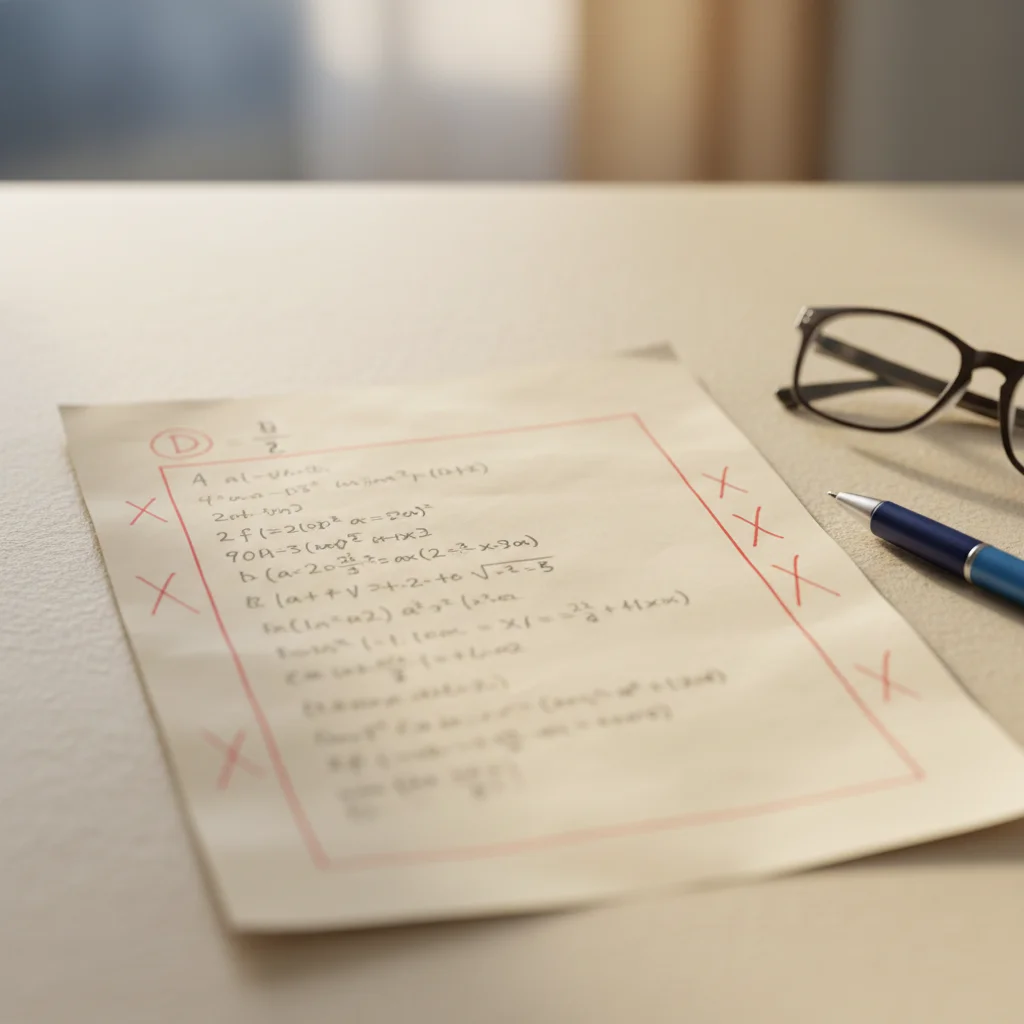
I have watched a lot of students walk out of a Maths SAC certain they did well, then get the paper back a week later and lose marks they never saw coming. Not because they did not know the content. Because of a handful of specific, avoidable mistakes that happen in and around the SAC itself, the kind nobody sits you down and warns you about.
This is that warning. Below are the recurring ones I see, and the concrete fix for each.
What are the most common mistakes in VCE Maths SACs?
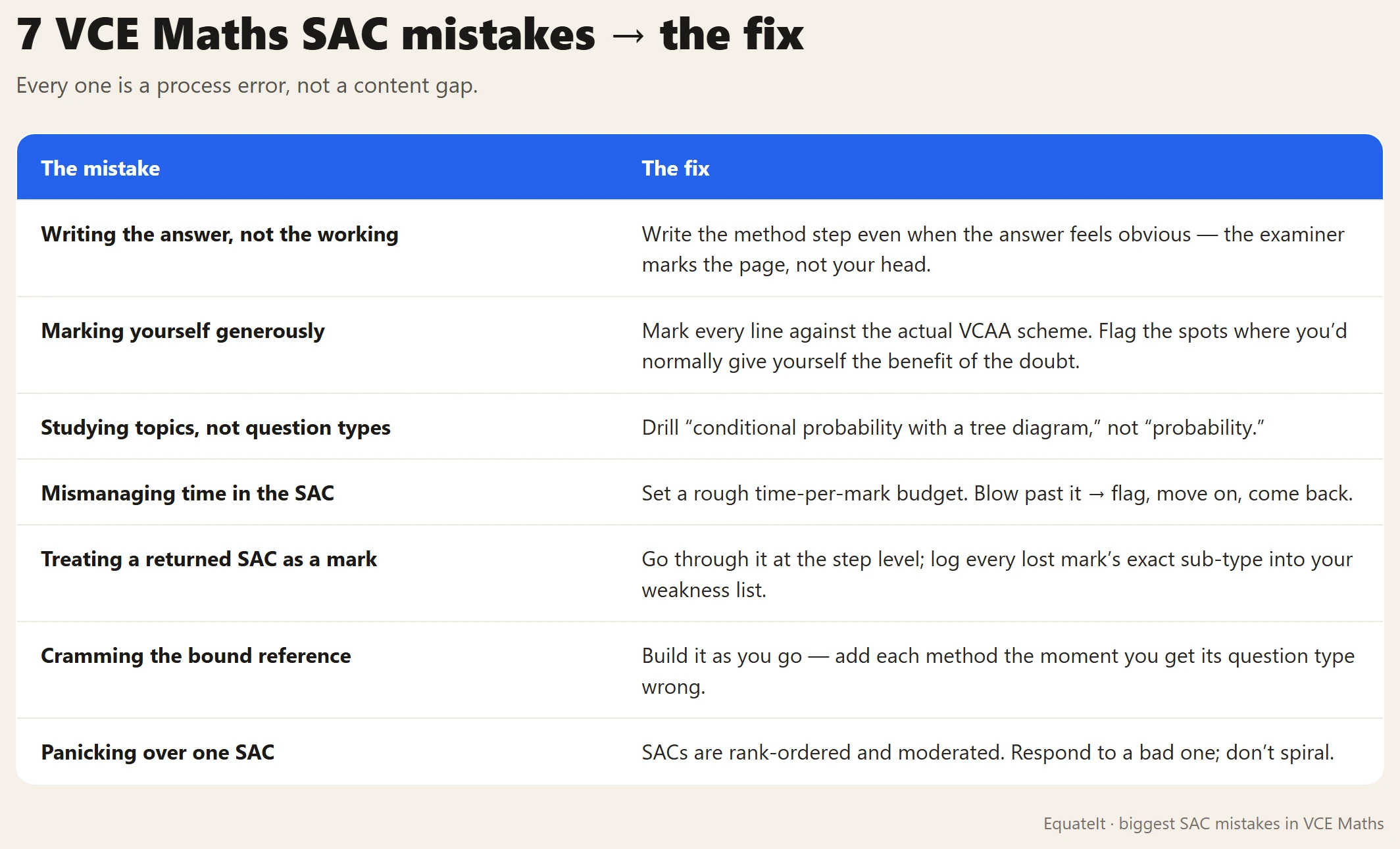
The most common VCE Maths SAC mistakes are not content gaps, they are process errors: skipping the working and writing only the final answer, marking your own practice generously instead of the way VCAA does, mismanaging time by dwelling on one hard question, treating a returned SAC as a mark instead of a diagnostic, and decorating a bound reference the week before instead of building it as you learn. Fix these and you pick up marks you are currently leaving on the table, without learning a single new topic.
Contents
- What are the most common mistakes in VCE Maths SACs?
- Mistake 1: Writing the answer, not the working
- Mistake 2: Marking yourself generously in the lead-up
- Mistake 3: Studying topics instead of question types
- Mistake 4: Mismanaging time inside the SAC
- Mistake 5: Treating a returned SAC as a mark, not a diagnostic
- Mistake 6: Why does cramming your bound reference backfire?
- Mistake 7: Does one bad SAC actually sink your score?
- The thread running through all seven
- One tool that removes the guesswork
Mistake 1: Writing the answer, not the working
This is the single biggest one, and it is entirely self-inflicted.
In Methods and Specialist, VCAA awards three kinds of marks: method marks for setting the problem up correctly, accuracy marks for the correct final answer, and consequential marks for correctly following through from an earlier step, even when that step was wrong. VCAA marks the journey, not just the destination — I break down exactly how each of those three mark types is awarded in a separate post.
What that means in practice: you can get the right final answer with the wrong method and still lose marks. You can make one slip early in a multi-step question and still pick up marks on every step after it, as long as you carry your (wrong) value through correctly.
Students skip the working because when you know what you meant, spelling it out feels redundant. But the examiner cannot see what you meant. They mark what is on the page. A right answer with no working shown is worth far less than it should be, and a wrong answer with clear working is often worth far more.
The fix: write the method step even when the answer feels obvious. Assume the person marking your paper can only see the page, not your head.
There is a second benefit too: working written out is something you can proofread. A wrong final answer with the steps shown is easy to trace back and fix. A wrong answer with nothing above it is just gone.
I go deeper on how VCAA actually marks each step in what I would do differently if I sat VCE Maths again.
Mistake 2: Marking yourself generously in the lead-up
This is the mistake I made, and I did not realise I was making it.
When you mark your own practice before a SAC, there is a quiet pull to give yourself the mark anyway. “I had the right idea.” “That was basically right.” “Just an arithmetic slip at the end.” I was calling steps close enough when a VCAA examiner never would have, and every time I did it I was training myself to accept a method that would not score.
That is the real cost. Marking yourself generously does not just inflate your practice results, it teaches you that a shaky method is fine, so you walk into the SAC repeating it.
The fix: mark every line against the actual VCAA marking scheme, not a vibe. When you would normally give yourself the benefit of the doubt, that is exactly the spot to flag. If you cannot mark yourself honestly, get something or someone that marks it for you at the step level, because the generosity problem is very hard to fix from the inside.
Mistake 3: Studying topics instead of question types
“I am bad at Methods” is the most useless thing you can know about yourself before a SAC. You cannot study “bad at Methods.” You can study “I keep dropping marks on related rates when the chain rule combines with a word problem.” One is an anxiety, the other is a plan.
VCAA SACs test question types, not vague topic areas. If you revise “calculus” broadly, you spread your limited time thin across things you can already do. If you revise the specific sub-types that keep costing you marks, every minute lands.
The fix: after each practice exam or returned task, write down the exact sub-type of every question you dropped marks on. Not “probability,” but “conditional probability with a tree diagram.” That list is your study plan. Then drill those types specifically. Working from a bank of questions sorted by area of study and sub-topic beats hunting through three years of VCAA past exams for one relevant example, which is its own quiet time sink.
Mistake 4: Mismanaging time inside the SAC
Plenty of capable students lose marks they clearly could have earned simply because they ran out of time, and almost always for the same reason: they got stuck on one hard question and would not let go.
The marks on the question you are stuck on are worth exactly the same as the marks on the next question, the one you could actually get. Every extra minute spent grinding a question that is not working is a minute stolen from marks sitting right there further down the paper.
The fix: before you start, set a rough time budget per mark, based on the total marks and total writing time. If a question blows past that budget, flag it, move on, and come back at the end with whatever time is left. Reading time helps here too: use it to skim the whole paper and spot your easy, high-confidence questions so you can hit those first once writing starts, instead of grinding sequentially from question one.
Mistake 5: Treating a returned SAC as a mark, not a diagnostic
This is the one that separates students who improve across the year from students who plateau.
When a SAC comes back, most students look at the total, feel something about it, and move on. That number is the least useful thing on the page. The useful part is which specific steps cost you marks and why.
The pattern I see on repeat: a student finishes a task, notes roughly which topics went badly, tells themselves they will go back to those, and then two weeks later the next SAC lands on exactly that content, never revisited. A mental note is not a system.
The fix: when you get the paper back, go through it at the step level. For every lost mark, was it a method mark, an accuracy mark, or a consequential mark? Write the exact sub-type into your weakness list, then actually drill it before it shows up again.
That returned SAC is the single best diagnostic you will get all semester, because it was marked under real conditions by the people who set the standard. The full method for turning a returned paper into a targeted plan is in what I would do differently if I sat VCE Maths again.
Mistake 6: Why does cramming your bound reference backfire?
If your SAC is open book and you spend two days beforehand copying formulas and colour-coding headings, you are not studying. You are decorating.
A bound reference thrown together the week before ends up looking like a textbook: neat, comprehensive, and built for the subject in general rather than for your specific weak spots. Under pressure in the SAC, a generic summary of the whole study design is slow to search and rarely has the one thing you actually needed.
The fix: build it as you go. Every time you get a question type wrong during the term, add that method to your bound reference right then, while you are learning it. By SAC day you have a reference that maps exactly to your gaps, not a decorated version of the study design.
And the time you save not decorating is time you spend on the thing that actually moves your mark: practising questions under marking conditions. If you do find yourself the night before with the reference still unfinished, the night-before-a-SAC plan is the two-hour, hard-stop version of what to do instead of panicking.
Mistake 7: Does one bad SAC actually sink your score?
A SAC that goes badly feels like the end of the world in the moment. It is worth understanding what one result actually does to your score, because the reality is less brutal than the panic.
VCE Maths is assessed across multiple SACs plus the end-of-year exams, so no single task is your study score. More importantly, School-assessed Coursework is statistically moderated. Per VCAA{target=“_blank”}, moderation “does not change the rank order of students as determined by the school’s school-based scores,” and any adjustment to your score “is determined by the external scores for the whole group, not by the student’s own external score.” In plain terms: your school rank on SACs is what carries through, and it is your cohort’s collective exam performance, not your individual off day, that shifts where the group’s marks land.
The fix: two things follow from this. First, do not spiral after one hard SAC, respond to it instead, using mistake 5 above. Second, because rank order is what sticks, every SAC matters as a ranking exercise, so there is no such thing as a SAC that “does not count.” For a fuller walkthrough of how VCE assessment fits together, how VCE exams and assessment work lays it out.
The thread running through all seven
Notice what none of these mistakes are: they are not “you did not know enough content.” Every one is a process error that happens in or around the SAC itself.
Show your working. Mark yourself honestly. Study question types, not topics. Budget your time. Mine the returned paper. Build the reference as you learn. Keep one result in perspective.
Fix these and you pick up marks you are currently leaving behind, without opening a single new chapter. That is the highest-leverage revision there is, because it costs you effort you are already spending, just spent better. If you’ve been hunting for vce sac tips that actually move your score instead of vague encouragement, this is how to study for a maths sac: fix the process, not just the content.
For the full weeks-out-to-exam-day version of this, the complete VCE exam checklist walks the same principles across the whole exam run.
One tool that removes the guesswork
Running all of this by hand means marking your own practice honestly (hard), tracking every dropped sub-type yourself (easy to forget), and hunting through past exams for targeted practice (slow). I built EquateIt around exactly these SAC mistakes because I lived every one of them growing up in regional Victoria with no real options.
The auto-marking scores the way VCAA does, step by step, not just the final answer, so the generous-marking problem is taken out of your hands. The weakness tracker records every question you drop marks on and sends you targeted practice on that exact sub-type until you are getting it right. The question bank is sorted by area of study and sub-topic, so drilling a specific weak question type takes seconds, not half an hour of hunting. If you would rather work with a person on it, our Melbourne VCE tutoring is built around the same targeted approach.
Once you’ve drilled the weak spots, pressure-test them with real VCAA Methods past exams under timed conditions — that’s what actually tells you if a SAC mistake is fixed.
If your Methods, Further, or Specialist SACs are not landing where you want, try EquateIt free. No credit card, 14 days. See whether marking your work the way VCAA does changes what you walk out of the next SAC believing.