 EquateIt
How to Build a VCE Bound Reference That Actually Helps (Methods & Specialist)

I spent two days before a SAC building a bound reference that looked incredible. Colour-coded headings, every formula from the study design, neat little boxes. I barely opened it in the actual exam. The parts I did reach for weren’t the parts I’d spent the most time on.
How do you make a good VCE bound reference?
A good VCE bound reference maps to your own mistakes, not to the textbook. Build it continuously across the year by adding a method the moment you get a question type wrong, organise it by area of study and question type rather than by chapter, and keep it to the things you actually forget under pressure: the traps, the CAS steps you fumble, the formulas that aren’t on the formula sheet. The reference that helps in the exam room is the one that reads like a record of your weak spots, not a summary of the whole course. And before you build anything, know which exams even allow one.
Which exams actually allow a bound reference?
This trips up more students than it should, so get it right first. Per VCAA’s authorised materials list{target=“_blank”}, a bound reference is permitted in Mathematical Methods Examination 2 only and Specialist Mathematics Examination 2 only. Exam 1 for both subjects is technology-free, and you cannot bring a bound reference in. So every entry you build is doing a job in exactly one paper per subject.
That changes what belongs in it. Exam 2 is CAS-active, so a reference full of hand-computation steps you’ll never do on that paper is wasted space. More on that below.
If you want the wider picture of how the two papers differ, our breakdown of the VCE maths exams covers what each one is testing.
What VCAA lets you put in it
The rules are more generous than most students realise, and knowing them changes how you build. Straight from VCAA{target=“_blank”}, a bound reference:
- must be in book format, A4 size or smaller when closed
- may have any number of pages (there is no page limit)
- must have permanently bound pages securely attached to a single spine (cloth, glue, staple, spiral or comb binding all count)
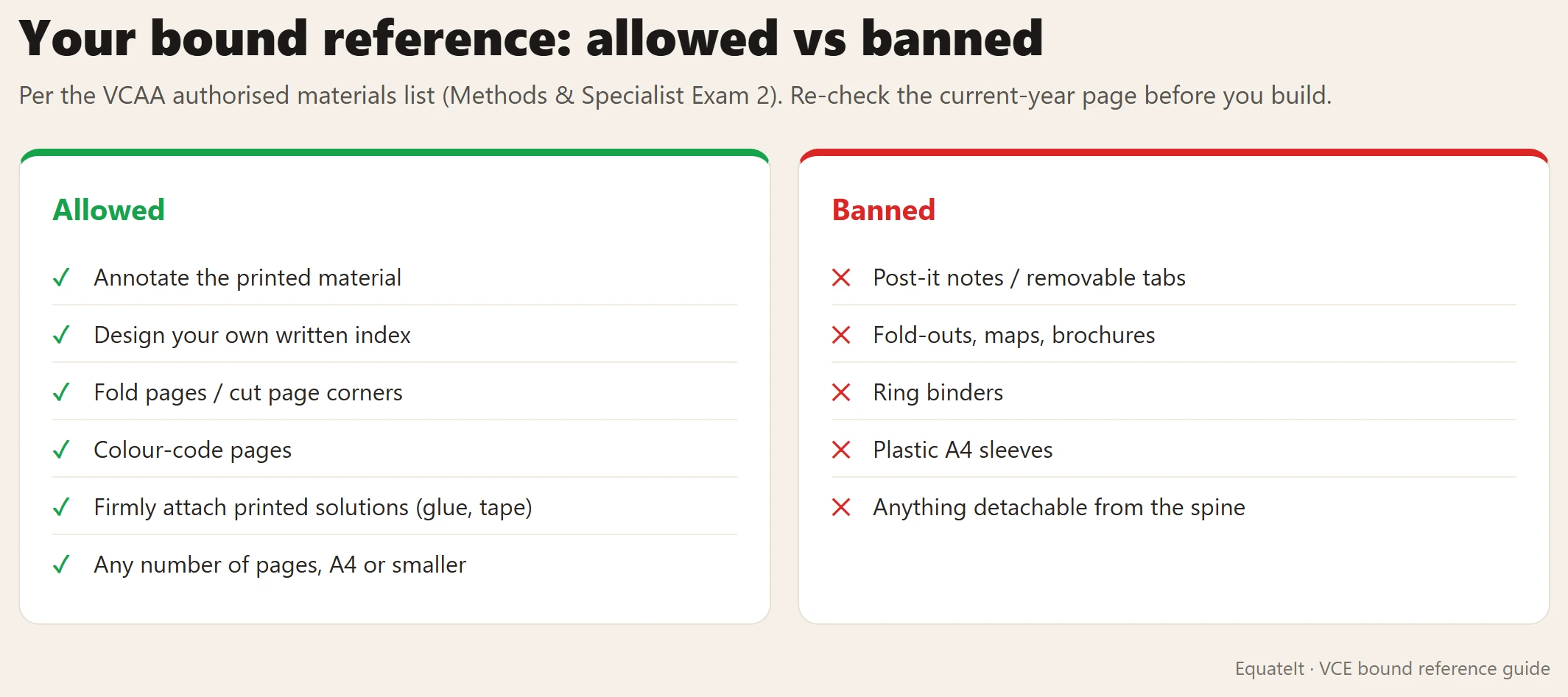
You are explicitly allowed to annotate the material, design your own written index, fold pages, cut page corners, colour-code pages, and firmly attach additional material to the pages. That last one matters: you can glue or tape printed worked solutions, exam-report extracts, or your own typed notes straight onto pages.
What’s banned is anything detachable: fold-outs, maps or brochure-style components, removable tabs, post-it notes, ring binders, and plastic A4 sleeves. If a page or part of a page can come away from the spine, the supervisor will remove it for the exam and log it as a potential rule breach. So the sticky-note-tab system a lot of students love is not allowed. Use a written index and cut corners instead.
One caveat on timing: these rules are current as of the 2026 VCAA authorised materials list. VCAA occasionally adjusts them year to year, so check the current-year page before you commit to a format.
Contents
- How do you make a good VCE bound reference?
- Which exams actually allow a bound reference?
- What VCAA lets you put in it
- The decorating trap (the thing that costs you the most)
- Organise by area of study and question type, not by chapter
- Fill it with your errors, not the study design
- Should you just buy someone’s bound reference?
- CAS shortcuts and UDFs worth storing
- Build it as you go, and keep it legible
- The honest summary
The decorating trap (the thing that costs you the most)
The biggest mistake isn’t a formatting one. It’s spending the two days before a SAC copying out formulas and colour-coding headings and calling it studying. You’re not studying, you’re decorating.
The time you spend making the reference beautiful is time not spent doing the thing that actually moves your mark: practising questions under marking conditions and fixing the gaps. A reference built in a batch the week before ends up looking like a textbook, neat and comprehensive and built for the subject in general, rather than for your specific weaknesses.
I’m not going to re-argue that case here, because I’ve already made it in full. This post is the practical layer underneath it: if the reference should map to your gaps, how do you actually build one that does?
Organise by area of study and question type, not by chapter
Here’s the shift. Most references are laid out like the textbook: Chapter 1, Chapter 2, and so on. That’s fine for the textbook because the textbook is a teaching tool. Your reference is a retrieval tool under time pressure. In the exam you don’t think “this is a Chapter 6 problem.” You think “this is a related-rates question and I always forget to differentiate implicitly first.”
So organise around how questions actually present:
- By area of study, then by question type inside it. Under “Calculus,” you want tabs (written, in your index, not physical) for optimisation, related rates, integration by recognition, and so on.
- One method per entry, written as the steps you’d take, not as a definition. Not “the chain rule is…” but “when you see a function inside a function: 1) identify inner and outer, 2) differentiate outer, 3) multiply by derivative of inner, 4) check you didn’t drop the inner.”
- A short written index at the front. Because tabs and post-its are banned, your index is how you find things fast. Page numbers, question types, one line each. In the exam room the difference between a reference you can search in ten seconds and one you have to flip through is real marks, because every second lost hunting is a second not spent solving.
Fill it with your errors, not the study design
The content test is simple: if you never get it wrong, it doesn’t belong in the reference. You don’t need the quadratic formula in there. You need the specific traps that cost you marks, over and over, in SACs and practice exams.
The best source for those is your own marked work. Every practice exam you sit off VCAA’s past exams is a list of the exact things you forget under pressure. When you drop a mark, the fix goes into the reference while you’re learning it, phrased as the trap: “domain restrictions on inverse functions, I keep forgetting to state them.” “Probability, check whether it’s with or without replacement before I start.”
Things worth including that students routinely leave out:
- Formulas that aren’t on the VCAA formula sheet. The formula sheet covers the standard ones. The derived results, the shortcuts, the ones your teacher gave you in class: those are the ones to store.
- Worked templates for question types you fumble. A full worked example of a hard integration-by-recognition problem, annotated with why each step happens.
- Exam-report phrasing. VCAA examiner reports spell out what students got wrong and what the assessors wanted to see. Firmly attach the relevant lines.
Should you just buy someone’s bound reference?
Short answer: no. A reference you buy, or copy off a friend who did well last year, was built for their gaps, not yours. It’s a decorated version of the study design with someone else’s weak spots baked in, which fails the one test that matters: it doesn’t map to the mistakes you keep making.
At most, borrow the structure. Never the content.
There’s a deeper cost. Building the reference yourself is the studying. Writing down a trap the moment you get it wrong is what makes it stick. Buy the finished article and you’ve skipped the part that actually moves the mark, then you reach for a book mid-exam that doesn’t hold the one thing you needed.
This is the exact problem EquateIt’s study books were built to solve, and it’s worth being upfront that the app runs on our own platform, ClassQuill{target=“_blank”}. Instead of a static book, EquateIt keeps a reference that updates over time from the questions you actually drop marks on, so it stays a record of your weaknesses rather than a summary of the study design, and you can add whatever you want to it. It filters the noise out for you, which frees up the time that should be going into the thing that matters most: practising questions.
CAS shortcuts and UDFs worth storing
Because the reference only comes into Exam 2, and Exam 2 is CAS-active, some of the highest-value entries are CAS ones. Most students learn their calculator to the surface level, solve an equation, graph a function, and stop. The reference is where you store the deeper stuff so you don’t have to remember it cold.
Worth including:
- User-defined functions (UDFs) you’ve set up for repeated tasks, with the exact syntax and a note on when to use them. Our guide to CAS calculator programs and UDFs for VCE goes through which ones are actually worth defining.
- The exact keystrokes for the CAS operations you fumble under pressure, screenshot or written out step by step.
- When to go by hand vs by calculator for the borderline cases, so it’s not a decision you’re making mid-question.
In VCE Maths your CAS can be make or break. Most students only know the surface level, and so do a lot of their teachers, because the manual is hundreds of pages and nobody reads it cover to cover. You only really learn it by seeing it used in context on real exam questions, over and over, and the reference is where that hard-won knowledge lives so it’s there on the day.
The format that works best is a cheat-sheet table: every function or UDF worth knowing, what it does, and — the part most people skip — which topics it’s actually useful for. But the table is only half of it.
The real secret is using these operations so much across the year that you understand not just how they work, but when to reach for them, and just as importantly when not to. A CAS shortcut you don’t fully trust is worse than doing the step by hand, because you’ll second-guess it under pressure. Know exactly when each one works and where it breaks, and the table becomes a genuine time-saver instead of a trap.
Build it as you go, and keep it legible
The mechanics that make all of the above work:
- Add to it the moment you get a question type wrong, not in a batch later. The correction is freshest right after you make the mistake, and building it in the moment means it’s genuinely yours.
- Keep it legible. You’ll be reading it under pressure. Handwriting you can’t parse at speed is a page you won’t use.
- Finish it before the night before. By exam week the reference should be done, not still being written. Where it fits into the rest of your exam-day logistics is covered in the exam-day checklist.
- Don’t lean on a borrowed reference — as above, take the structure, never the content.
The honest summary
A bound reference is not a trophy and it’s not a security blanket. It’s a tool that does one job in one paper per subject: give you fast access to the specific things you forget under pressure. Build it from your own marked errors, organise it the way questions actually present, load the CAS entries that matter for Exam 2, and keep the whole thing continuous rather than crammed. Do that and you’ll have a reference you actually reach for, instead of a beautiful book you built and barely opened.
The reason I built EquateIt around this is that the hardest part isn’t the binding, it’s knowing which errors are actually costing you marks. The platform tracks every question you drop marks on and sorts your practice by area of study and sub-topic, so the list of what belongs in your reference builds itself from what you’re genuinely getting wrong.
If you’re in Year 11 or 12 and your Methods or Specialist marks aren’t where you want them, or you’re a parent in Melbourne looking at tutoring options, try EquateIt free. No credit card, 14 days, see if it helps.