 EquateIt
How VCAA Actually Marks Your VCE Maths Exam (Method, Accuracy & Consequential Marks)

I remember handing in a practice exam, checking it against the answers, and feeling pretty good. Most of my final answers matched. Then I sat down with someone who actually knew how VCAA marks, went through the same paper line by line, and watched my score drop.
Same answers. Fewer marks.
That was the moment I understood something nobody had spelled out for me: in VCE Maths, the number in the box at the bottom is not the thing being marked. The working above it is.
How does VCAA mark VCE Maths exams?
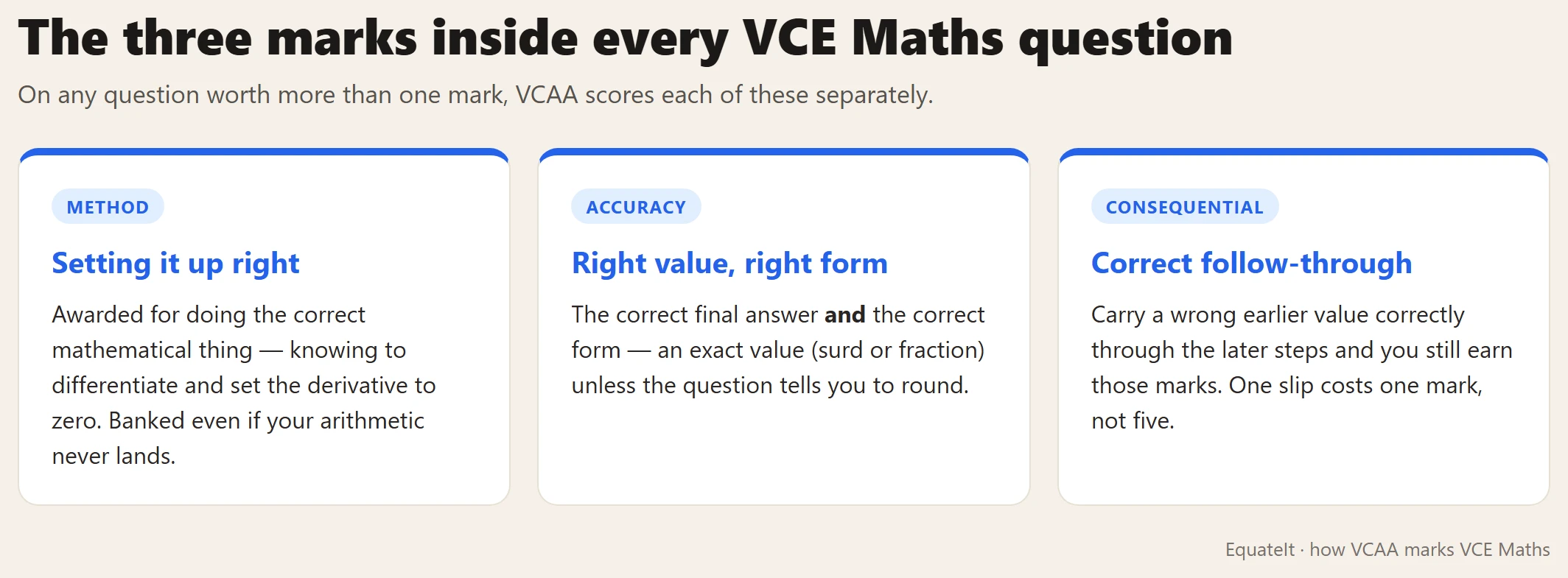
VCAA marks the working, not just the final answer. Inside a VCE Maths exam there are three kinds of marks: method marks for setting the problem up correctly, accuracy (answer) marks for the correct final value, and consequential (follow-through) marks for correctly carrying a wrong earlier result through the later steps. Because the standard exam instruction is that in questions worth more than one mark, appropriate working must be shown (VCAA exam specifications{target=“_blank”}), a correct final answer with missing or wrong working can still lose marks, and one slip early in a question does not have to cost you the whole thing.
That single idea changes how you should practise. Let me break down each mark type, then show you how to see it for yourself in an examiner’s report.
Contents
- How does VCAA mark VCE Maths exams?
- Method marks: you get paid for setting it up right
- Accuracy marks: the right final answer, in the right form
- Consequential marks: a wrong step early can still score
- Why does the right answer with wrong working still lose marks?
- How to read an examiner’s report (and see the marks for yourself)
- How should this change the way you study?
- The short version
Method marks: you get paid for setting it up right
A method mark is awarded for doing the correct mathematical thing, whether or not your arithmetic lands. If a question asks you to find where a curve has a stationary point, the method mark is for knowing to differentiate and set the derivative to zero. Do that, and the mark is yours even before you solve anything.
This is why “I didn’t know how to finish it, so I left it blank” is the most expensive habit in VCE Maths. On a multi-mark question, writing down the setup, the rule you’re applying, the equation you’re about to solve, often banks a mark on its own. Examiners are looking for evidence you knew the pathway. A blank space is evidence of nothing.
In Mathematical Methods and Specialist, Exam 1 is short-answer and technology-free, so your written method is the answer. There’s nowhere to hide a leap of logic. If you skip from line two to the final value, you’re asking the examiner to assume you did the middle correctly, and they won’t.
Accuracy marks: the right final answer, in the right form
The accuracy mark (often called the answer mark) is the one most students think of as “the mark.” It’s for the correct final value. The catch is form: VCAA Maths generally wants an exact value unless the question tells you to round. Write 1.41 when the answer is √2, or a rounded decimal when an exact surd or fraction was expected, and you can hand back the accuracy mark even though you did everything right.
So the answer mark has two conditions, not one: correct value and correct form. This is a pure-marks-left-on-the-table category. You knew it, you worked it, and you lost it on presentation. Reading past papers alongside the VCAA past exams and examiner reports is the fastest way to calibrate what “acceptable form” looks like for each question type.
Consequential marks: a wrong step early can still score
This is the part almost nobody explains, and it’s the most reassuring thing to understand before you walk in.
VCAA marking is consequential, sometimes called follow-through. On a multi-step question, if you make an error at step one but then carry that wrong value correctly through steps two, three and four, you can still earn the marks for those later steps. You lose the mark tied to the mistake itself, but the method and reasoning after it are assessed on their own terms.
Picture a multi-part question where part (a) gives you a value you then use in part (b). Say you slip in part (a) and get the wrong number. If part (b) is marked consequentially, plugging your (wrong) part (a) answer into the correct part (b) method still earns the part (b) marks. One arithmetic slip costs you one mark, not five. (That’s the structure of how it works; the exact split on any given question lives in that year’s examiner’s report, not in my head — which is exactly why the report-reading routine below is worth the effort.)
The practical lesson: never abandon a question because you think you got an earlier part wrong. Keep going, use your own earlier answer, show every step. The marking scheme is built to reward exactly that.
Why does the right answer with wrong working still lose marks?
Put method, accuracy and consequential marks together and you get the counter-intuitive truth: a correct final answer is neither necessary nor sufficient for full marks.
Not sufficient, because on a multi-mark question the instruction to show appropriate working is real. Land the right number with a couple of magic lines and no visible method, and you can be capped below full marks, because you haven’t given the examiner the evidence the method mark is paying for.
Not necessary, because consequential marking means a wrong final number can still carry most of the marks if the working is sound.
Communication is being assessed alongside the maths. The exam is not asking “is your answer right,” it’s asking “can you show, clearly, that you know how to get there.” Once that clicks, “I got it right but only got 2 out of 3” stops being a mystery and starts being a checklist.
How to read an examiner’s report (and see the marks for yourself)
You do not have to take any of this on faith. VCAA publishes an examination report for every exam, every year, and it is the single most under-used free resource in VCE Maths. You can find them on the VCAA past exams and examiner reports hub, sitting right next to the paper itself.
Here’s how to actually use one, rather than skim it:
- Do the question first, under exam conditions. Mark it yourself before you read a word of the report.
- Open the report to that question. It typically shows the percentage of students who scored each mark, and describes the correct solution and the common errors.
- Compare where the marks sat, line by line. The report tells you which step earned which mark. That’s the marking scheme, made visible.
- Read the “common errors” note like it’s about you, because it usually is. Lines like “students did not show sufficient working” or “many gave a decimal where an exact value was required” are VCAA telling you, in writing, where the marks leak.
Do this across a few papers and you stop guessing how you’re being marked. You’re reading it from the source. My full routine for working through papers this way is something I’ll walk through in a dedicated post soon.
How should this change the way you study?
If VCAA marks the working, then marking your own practice by the answer is training the wrong skill.
When I marked my own practice exams, there was always a pull to give myself the mark anyway: “I had the right idea,” “basically right,” “just an arithmetic slip at the end.” But VCAA doesn’t mark you the way you mark yourself generously. It marks the journey, not just the destination. Marking a step “close enough” when an examiner wouldn’t have is quietly training yourself to accept a wrong method. If I were doing it again, I’d mark every line against the actual scheme, not the answer key.
So, concretely:
- Mark against the scheme, not the answer key. Use the examiner’s report to award marks step by step, the way an assessor would.
- Write the setup even when you’re stuck. Bank the method mark.
- Keep going after a slip. Consequential marking is on your side.
- Check the form of every answer. Exact value unless told otherwise.
This is exactly why I built EquateIt’s auto-marking to work the way VCAA marks, step by step, rather than just checking the final answer. Growing up in regional Victoria I didn’t have anyone who could mark my working the way an examiner would, so I know what that gap costs.
If you keep “getting it right” but not getting the mark, the fix usually isn’t more content. It’s marking yourself honestly, the way the exam does. There’s more on that mindset in what I’d do differently if I sat VCE Maths again.
The short version
VCAA marks three things: your method, your answer, and your ability to follow through correctly from your own earlier work. The final number in the box is only one of them. Show your setup, keep going after a mistake, get the form right, and mark your practice the way the examiner’s report tells you to, not the way that feels generous at 11pm. Our VCAA Methods past exams page links every paper and its matching examiner’s report so you can do exactly that.
If you want someone marking your working the way VCAA actually does it, EquateIt’s auto-marking scores every step, not just the answer, and our tutors in Melbourne and across Victoria build sessions around the exact steps where your marks are leaking. You can try it free for 14 days. No credit card. See where your marks are actually going.