 EquateIt
How to Top Your VCE Exams: The Complete Checklist
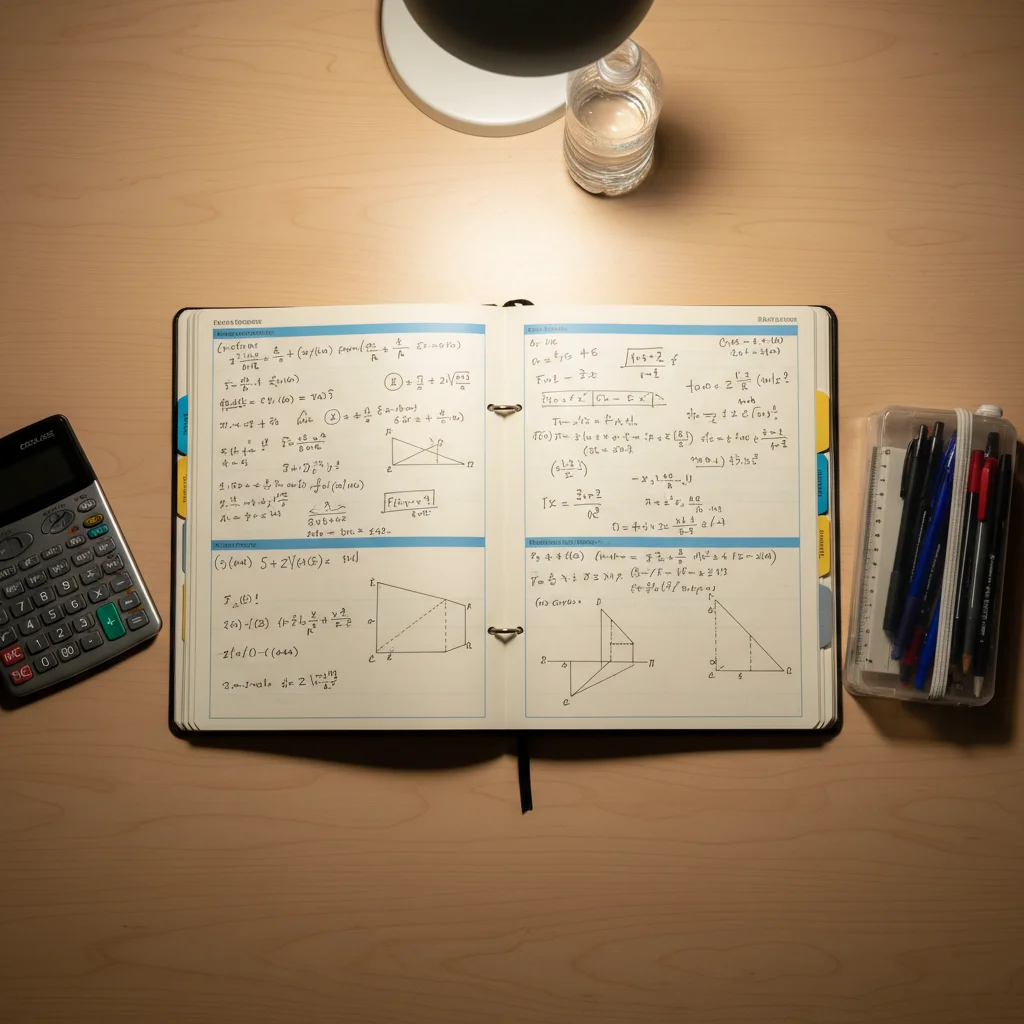
What do I need to do to top my VCE exams?
Topping your VCE exams comes down to five phases, not one big push. Six to eight weeks out, run a diagnostic on every SAC and practice exam you’ve sat this year and build your revision plan around your actual weak question types — not a full re-cover of every topic. Three to four weeks out, sit full past VCAA exams under real timed conditions and mark every step the way an examiner would, not the way you’d mark yourself. In the final week, taper: fewer new questions, more precision, and your logistics sorted before the night before. On the day, use your 15 minutes of reading time to plan your attack order, not to panic-read. In the exam, show every step even when you’re sure of the answer — that’s where marks actually leak. None of this requires more hours. It requires the right hours, in the right order.
Contents
- The checklist at a glance
- 6-8 weeks out: build the foundation
- 3-4 weeks out: practise like it’s the real thing
- The final week: taper, don’t cram
- The night before
- What should you bring on exam day, and how do you use reading time properly?
- In the exam: the technique that protects marks
- Between exams: protect the next one
- What actually separates 40+ students from everyone else?
The checklist at a glance
| Phase | Timeframe | Key actions |
|---|---|---|
| Build the foundation | 6-8 weeks out | Diagnostic on weak question types; start your bound reference |
| Practise like it’s real | 3-4 weeks out | Full timed past exams; mark like an examiner; CAS fluency |
| Taper | Final week | Less volume, more precision; logistics sorted early |
| The night before | 12-24 hrs out | Two hours, hard stop, sleep — full plan here |
| Exam day | The day | What to bring; use reading time properly; know the CAS-memory rule |
| In the exam | During | Show every step; don’t dwell; flag and move |
| Between exams | After each paper | No corridor post-mortems; reset before the next one |
6-8 weeks out: build the foundation
Run your diagnostic
Don’t start revision by re-covering everything you’ve done since Unit 3. Start by finding out exactly where your marks have actually been leaking — every SAC, every practice exam, every returned piece of work this year is a record of your real weak points. “I’m bad at Methods” isn’t a diagnostic. “I keep losing marks on related rates when the chain rule combines with a word problem” is.
- [ ] Pull every SAC and practice exam you’ve sat this year
- [ ] List the specific question sub-type of every mark you dropped — not the topic, the sub-type
- [ ] Rank that list — the 3-5 sub-types costing you the most marks are your revision plan
The full method for turning “I’m behind” into a specific, prioritised plan lives in what I’d do differently if I sat VCE maths again — this is the step most students skip entirely, and it’s the highest-leverage thing on this whole list.
Start your bound reference now, not later
Building your bound reference in the days before the exam isn’t studying — it’s decorating. A bound reference put together the week before ends up looking like a textbook: neat, comprehensive, and built for the subject in general rather than for your specific weaknesses. The version that actually helps you in the exam room is the one you built continuously — adding a method the moment you get a question type wrong, so that by exam time it maps exactly to the gaps you’ve had all year, not to what a template says you should include.
- [ ] Add to your bound reference the moment you get a question type wrong — not in a batch later
- [ ] Check it reflects YOUR weak topics, not a generic subject summary
- [ ] If you’re borrowing someone else’s bound reference, know it was built for their gaps, not yours
3-4 weeks out: practise like it’s the real thing
Full past VCAA exams under timed conditions
This is where most students under-practise the thing that actually matters: sitting a complete, timed exam and finishing it the way you’ll have to on the day. Doing individual questions builds content knowledge. Sitting a full paper under time pressure builds the thing that content knowledge alone doesn’t — pacing, stamina, and the judgement call of when to move on from a question that isn’t working.
- [ ] Sit at least one full past VCAA exam under strict timed conditions per subject
- [ ] Use recent past exams that match your current study design — older exams under a superseded design can test content or question styles you won’t see
- [ ] Simulate the real conditions: no notes unless the exam is open-book, phone away, one sitting
The number of papers matters less than what you do with them, and there’s diminishing return past a certain point. Five full past exams is a reasonable target: sit them, then go through each one with your study design next to you looking for patterns, not just individual mistakes, which sub-types keep costing you marks, which error types recur. Revise that specific area properly, then sit more exams to confirm the gap has actually closed. The exams are a diagnostic tool, not the study itself.
Mark every step like an examiner
Marking your own practice exam generously is the single most common way students overestimate their readiness. VCAA awards method marks, accuracy marks, and consequential marks — you can get the right final answer with the wrong working and still lose marks, and you can make an early error and still pick up marks downstream if you carry through correctly. The full breakdown of how this plays out and what to actually check for is in what I’d do differently if I sat VCE maths again. This is one reason having a tool mark your practice exams against the actual VCAA criteria matters, it takes the generosity problem out of your hands entirely, because it’s not marking on a vibe.
- [ ] Mark every practice exam against the actual VCAA marking scheme, not a vibe check
- [ ] Flag any question where you gave yourself a mark you wouldn’t get from a real examiner
- [ ] Track sub-topics where marking-scheme errors keep recurring, not just content errors
Get your CAS cold
If you’re slow on your calculator, or doing calculations by hand your CAS could do in seconds, you’re losing time and accuracy on every CAS-active question. How to Ace VCE Mathematical Methods covers the specific CAS technique in depth — the short version for this checklist: know your calculator well enough that using it isn’t a decision you have to make mid-question.
- [ ] Time yourself doing CAS-active questions — flag anything that takes longer than it should
- [ ] Know which questions are faster by hand vs by calculator, so you’re not guessing under pressure
The final week: taper, don’t cram
Reduce volume, increase precision
The final week isn’t for closing gaps that needed weeks to close — it’s for reinforcing what’s already there. Trying to cover new ground this late usually means doing it shallowly, which costs you confidence without adding real marks.
- [ ] Stop opening new topics — focus entirely on your ranked weak-topic list from 6-8 weeks out
- [ ] Fewer, more targeted questions — not more volume
- [ ] Keep sleep and routine consistent; this is not the week to change your schedule
The goal for the final week is to walk in relaxed and rested, not wired from a week of cramming. A student who’s still trying to force in new content the night before an exam is usually more anxious walking in than one who tapered properly, and that anxiety costs marks of its own, on top of the shallow content it bought them.
Sort your logistics before the night before
Confirm the practical details now, not at 11pm the night before your first exam: your exam room and time, what materials are actually permitted for each subject (check the VCAA Exam Navigator for your specific subjects), and that your bound reference is finished and legible.
- [ ] Confirm your exam room, session time, and seat number if published
- [ ] Check permitted materials per subject in the VCAA Exam Navigator
- [ ] Have your bound reference finished — not still being written the night before
The night before
The same principle from a SAC applies here, just with higher stakes: the night before a final exam is for consolidation, not new learning. Pick your 2-3 weakest question types, do one question each with proper step-level marking, and stop by a reasonable hour. The full two-hour, hard-stop plan — including what NOT to do and how it differs across subjects — is in the night-before-a-SAC plan; the mechanics are identical for a final exam, the only difference is the stakes make it even more tempting to break the plan. Don’t.
One thing that’s different for a final exam versus a SAC: pack your bag the night before, not the morning of. ID, pens, calculator, bound reference, water — sorted the night before means one less decision when you’re already nervous in the morning.
- [ ] Pick 2-3 weakest question types, one question each, marked properly
- [ ] Pack your exam bag the night before — ID, stationery, calculator, bound reference, water
- [ ] Stop by a reasonable hour and sleep
What should you bring on exam day, and how do you use reading time properly?
What to bring
Per VCAA’s official exam rules and authorised materials list, arrive at least 30 minutes before your exam starts, and bring:
- [ ] Photo ID and your examination advice slip / student ID card
- [ ] Pens, pencils (especially for multiple-choice), highlighters, erasers, sharpeners, and a ruler
- [ ] All of the above in a clear bag or clear pencil case — not an opaque pencil case
- [ ] Your calculator (check which type is authorised for that specific exam)
- [ ] Your bound reference and/or dictionary, if permitted for that exam
- [ ] Water in a clear, label-free bottle
Reading time — the 15 minutes most students waste
Every VCE exam starts with 15 minutes of reading time (unless the exam specifies otherwise). During this time you can read the instructions, the question book, and your dictionary or bound reference where permitted — but you cannot write, mark your paper, or use a calculator until writing time is formally announced.
Most students either panic-read or try to start solving in their head. Neither is the best use of 15 minutes.
- [ ] Skim the whole paper first — know what’s coming before you commit to an order
- [ ] Identify your easiest, highest-confidence questions — plan to hit those first once writing starts
- [ ] Flag anything that looks unfamiliar so it doesn’t ambush you mid-exam
- [ ] Do NOT start writing, marking, or using your calculator — it’s against the rules, and it also means you’re rushing a plan instead of making one
- [ ] Note the mark allocation next to each question as you skim, and try to categorise what each one is actually testing before writing time starts
The CAS memory myth
A genuinely common misconception worth correcting directly: your CAS calculator’s memory does not need to be cleared before a VCE exam. Per VCAA’s approved technology page, “the full functions of approved CAS calculators may be used (that is, memories do not have to be cleared prior to entering the examination).” Don’t waste exam-morning anxiety on a rule that doesn’t exist — check that page directly if you’re unsure about your specific calculator model.
In the exam: the technique that protects marks
Show every step, even when you’re sure
The single most common way students lose marks they don’t need to lose isn’t a content gap — it’s skipping the reasoning step. They go straight from the setup to the final answer and leave out the working VCAA actually requires in the middle. It’s not that they don’t know how to do it; they just don’t write it down, because when you know what you meant, it feels redundant to spell it out.
But an examiner marking your paper doesn’t know what you were thinking — they mark what’s on the page. VCAA marks the step, not the intention.
Writing every step out has a second benefit beyond the marks: it means less of the calculation happens in your head, which is where careless errors creep in, and it gives you something concrete to proofread. A wrong final answer with the working shown is easy to check back through; a wrong final answer with no working is just a wrong answer.
- [ ] Write out the method step even when the answer feels obvious
- [ ] Assume the examiner can only see what’s on the page — not what you meant
Don’t dwell — flag and move
If a question isn’t working after a reasonable attempt, mark it to come back to and move on. The marks on the question you’re stuck on are the same value as the marks on the next one you could actually get.
- [ ] Set a rough time budget per mark before you start, based on total marks and total time
- [ ] If you’re stuck past that budget, flag it and move to the next question
- [ ] Come back at the end with whatever time is left — don’t lose marks elsewhere chasing one question
Between exams: protect the next one
If your first exam doesn’t go the way you wanted, the worst thing you can do is spend the walk out comparing answers with friends in the corridor. You’ll get details wrong from memory, convince yourself of mistakes that didn’t happen, and carry that anxiety straight into your next exam — for a subject that has nothing to do with the one you just finished.
- [ ] Don’t discuss specific answers with friends straight after an exam
- [ ] One exam is not your whole study score — VCE has multiple assessment components
- [ ] Reset with something unrelated (food, a walk, a short break) before opening your next subject’s notes
What actually separates 40+ students from everyone else?
It isn’t intelligence, and it isn’t hours logged. The students who consistently score 40+ are the ones who know exactly where their marks are going — not just that they did a practice exam, but which specific step broke down and why. Most students who plateau have the same problem: they finish a practice exam, mark it, move on, and repeat the same error two weeks later. Not because they don’t know the content, but because they’ve never had proper feedback on what specifically went wrong at the step level — so the same gap just resurfaces, exam after exam.
Every item on this checklist comes back to that one mechanism: targeted practice, marked properly, on your actual weak spots — not volume for its own sake. Doing more practice exams on its own doesn’t move your score; closing the specific knowledge gaps they reveal does. That’s the difference between a study plan that feels productive and one that actually moves your score.
One tool that helps you tick these off
Running this checklist properly by hand means hunting through old SACs to find your weak sub-topics, marking every practice exam step-by-step yourself, and building a bound reference that updates as you go. EquateIt’s question bank is sorted by topic and sub-topic, auto-marks the way a VCAA examiner would — step by step, not just the final answer — and tracks your weaknesses automatically so your revision plan builds itself from what you’re actually getting wrong.
If you’re weighing up whether a tutor, an AI tool, or both makes sense for the stretch between now and your exams, AI tutoring vs human tutoring lays out the honest comparison.
Try EquateIt free at equateit.com.au/quote — no credit card, 14 days, built around exactly this checklist.